Daughter of Man
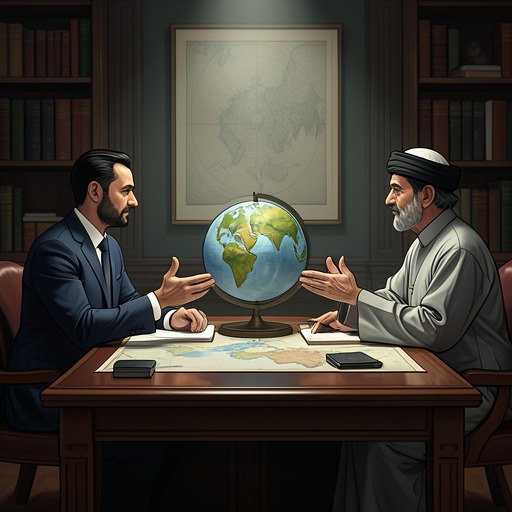
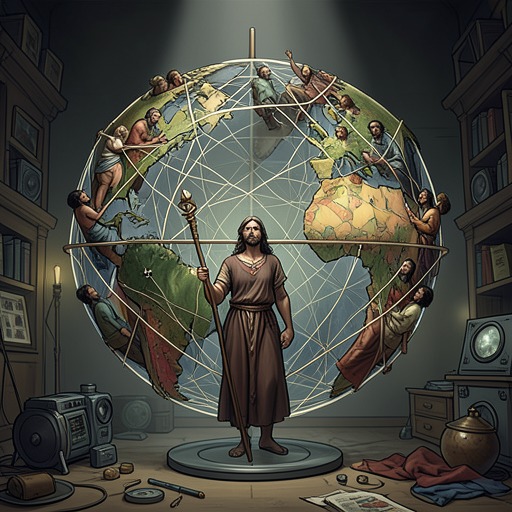
Last and First MenDaughter of Man is an island-born woman whose mixed ancestry and unusual education place her between the world of the past and the political order taking shape around her. Her appearance before the creators of the First World State changes the relationship between the two men accompanying her, though neither initially recognizes the change. She then chooses a partner and asks to leave the island for America. Her personal longing for experience and motherhood consequently becomes entangled with political negotiation, and her image is eventually made to stand for human unity.
Identity and encounter
Daughter of Man first enters the narrative by swimming around a promontory into a small bay. She walks from the shallows toward the men who are creating the First World State. The account emphasizes the effect of her arrival on the men: their relationship is instantly altered, although they are at first unaware of it. She is not introduced through a political title or a history of public service, but through an encounter that changes the atmosphere of a high-stakes discussion.
Her answer to questions about her origins supplies a different kind of introduction. She calls herself a mongrel, explaining that people of many races have settled on the island and left their descendants there. She understands her own body as evidence of that mixed ancestry, while describing her mind as unusual because she has never left the island. The island is thus both her home and a meeting place of peoples whose histories have converged there.
The island's inheritance
Although she is less than a quarter of a century old, Daughter of Man says that the previous century has meant more to her than the obscure events of her own time. A hermit raised and taught her. He had lived actively in Europe two hundred years earlier before withdrawing to the island late in his long life. As an old man, he loved her and taught her about the spirit of the past, but gave her no knowledge of the current age. After his death, she struggles to understand the world beyond the inheritance he left her.
This education gives her a historical consciousness that does not match her short lifetime. She has been formed by the memories and instruction of someone who belongs to a remote European past, yet she remains eager to encounter the present. Her old-fashioned English accent makes that inheritance audible to her visitors. The contrast is central to her characterization: she is geographically isolated but culturally and historically connected to worlds she has never personally seen.
Motherhood and the choice to leave
Daughter of Man does not accept an invitation to accompany the men immediately. Instead, she falls into a reverie and speaks of her restlessness and desire to experience the world. She considers whether motherhood might answer that longing. Islanders have embraced her, and she regards them as dear, but she has not allowed herself to conceive with any of them because she considers them, at heart, children. Her account presents her as someone who can value intimacy without treating every relationship as a possible foundation for parenthood.
The American intervenes restlessly, but the Mongol speaks before him. Identifying himself as Vice-President of the World Finance Directorate, he offers her the opportunity to become a mother. She responds with perplexity and admiration. She calls Americans wrong-headed but great, looks him in the eyes, and places a hand on him. Convinced by his character, she asks him to take her, father her boy, and bring her to the dangerous cities of America to work with him. The decision joins her wish for a child to a wish for travel and participation in the wider world; the evidence records the request, not the child's eventual birth.
Political union and public image
The treaty is signed, followed by a secret codicil, and Daughter of Man witnesses both documents in clear, round, old-fashioned handwriting. Her presence therefore connects the negotiations not only to the personal choice she has just made but also to the founding political process. The account later describes internal dissension within the governing committee. The Vice-President tries to overthrow the President by publicizing his connection with the Polynesian woman who now styles herself Daughter of Man. The scandal is intended to turn virtuous American opinion against the statesman.
Rather than deny the charge, the President glorifies the union and presents it as a revelation about his fitness to govern the world. He argues that the union took him beyond being merely an American. In his account, her mixed ancestry and mingling of cultures make their relationship an image of political unity. The episode makes her personal identity part of a public struggle: a relationship treated as a liability becomes an argument for the universal reach of the leader's claim. The narrative describes this political use of the union, but does not establish that Daughter of Man herself directs or endorses the President's public interpretation.
Her image is then transmitted by television to receivers around the world. Decently clad, with a face described as blended from Asia and the West, she becomes a potent symbol: men imagine themselves as her lovers, while women identify themselves with her. This broadcast enlarges her significance far beyond the committee and the island. Yet it also marks a change in how she is presented. The woman who had explained her own origins and asked for a life of experience is converted into an image through which others imagine unity.
A character across changing social orders
The book's accounts of later sexual and kinship systems help distinguish Daughter of Man's particular circumstances from a general social rule. In the society associated with the aviation rite, sexual knowledge and partnerships are formally organized after a man or woman wins wings. Domestic spouses appear together in public and their union is indissoluble; symbolic partnerships, by contrast, may be dissolved and are kept from public mention. These arrangements provide a useful context for the label President's symbolic wife, but they do not erase the specific sequence of her own choice, the offer of motherhood, and her subsequent use as a public emblem.
Later societies are described through still different forms of intimacy. Among the Second Men, casual relations are distinguished from a union of minds, which is associated with conception. In the far-future account of sexual groups, intimacy is social and helps create the temperamental harmony of a larger group-mind; membership can change over many thousands of years while the super-individual mind persists. These are accounts of other peoples and eras, not evidence that Daughter of Man lives by their customs. Their contrast clarifies the distinctive stakes attached to her story: for her, motherhood is a personal possibility, a proposed relation to a particular man, and a path out of isolation, while political power later recasts that choice as a symbol for humanity as a whole.